


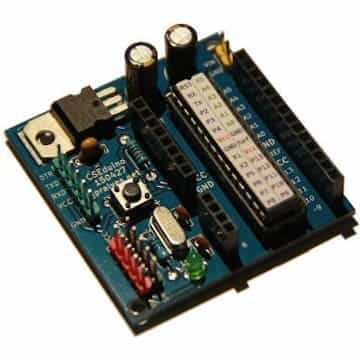
Other
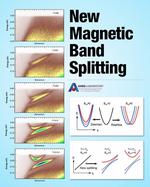
“Newly discovered Fermi arcs that can be controlled through magnetism could be the future of electronics based on electron spins. These new Fermi arcs were discovered by a team of researchers from Ames Laboratory and Iowa State University, as well …
“Study by the University of Bonn could pave the way to new types of highly sensitive sensors Researchers at the University of Bonn have created a gas of light particles that can be extremely compressed. Their results confirm the predictions …
“Collisions of light with deuterons offer insight into gluelike particles that bind the building blocks of matter—and what it takes to break protons and neutrons apart. Scientists have found a new way to “see” inside the simplest atomic nuclei …
“The research project INSPIRE develops a unique printing technique for large-scale production of optical chips consisting of layers of different materials. Faster, more energy-efficient ICT, or sensors to detect anything between beginning fruit rot and microscopic cracks in glass fibers …
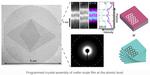
“Lego blocks, beloved by both children and adults, can be assembled into set models like space shuttles or cool buildings, but also can be used to build any new structures. Like these blocks, a new technology has been proposed to …

“Physicists know about the huge chasm between quantum physics and the theory of gravity. However, in recent decades, theoretical physics has provided some plausible conjecture to bridge this gap and to describe the behaviour of complex quantum many-body systems, for …
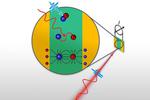
“Semiconductor electronics is getting faster and faster - but at some point, physics no longer permits any increase. The shortest possible time scale of optoelectronic phenomena has now been investigated. How fast can electronics be? When computer chips work with ever …
“A team co-led team by the University of Surrey has successfully increased the levels of energy absorbed by wafer-thin photovoltaic panels by 25%. Their solar panels, just one micrometre thick (1μm), convert light into electricity more efficiently than others as …
“A University of Rochester project uses flat panel technology to build a more cost-effective device that can also function as a touch interface. Over the past decade, smart devices have become essential components of daily life: doorbells, watches, keychains—even …
News Smart Textiles and New Materials for Electronics: Current Developments and Potential Applications
“What kind of high-tech materials for the electronics, power, and textile industries are being made in Russia? Which projects are developed in St. Petersburg and what is their potential? These and other questions were discussed at a recent TASS news …