

Other

“An ERC Proof of Concept grant is enabling Aalto University to work on a novel concept for a tunnelling accelerometer using graphene’s unique properties. If successful, the project could appeal to industries producing high-precision applications. Accelerometers are used in …

““Laser-Induced Graphene by Multiple Lasing: Toward Electronics on Cloth, Paper, and Food” Electronics, the lifeblood of the modern world, could soon be part of our daily diet. In a study appearing in ACS Nano, scientists report that they have developed …

“Engineers from UCLA, 4 other universities produce nanoscale device that mimics the structure of tree branches Mechanical engineers from the UCLA Henry Samueli School of Engineering and Applied Science and four other institutions have designed a super-efficient and long-lasting electrode …
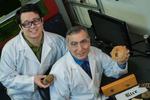
“Researchers at Rice University say they have produced edible graphene, which could serve as the basis of an entirely new class of edible electronics. Rice chemists have found a way to print graphene onto common items such as bread or …

“A new low-cost ultra-stretchable sensor can do more with less Creating the perfect wearable device to monitor muscle movement, heart rate and other tiny bio-signals without breaking the bank has inspired scientists to look for a simpler and more affordable …

“A new materials-based approach by Kaustav Banerjee yields a smaller, higher-performing alternative to the classic design A basic building block of modern technology, inductors are everywhere: cellphones, laptops, radios, televisions, cars. And surprisingly, they are essentially the same today as …
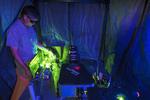
“In the study, a collaborative research team showed that Raman spectroscopy (a form of light scattering) can provide more extensive characterization of intertube excitons. Nanotechnology researchers studying small bundles of carbon nanotubes have discovered an optical signature showing excitons bound …
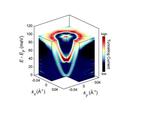
“Unprecedented characterization of subsurface electronic states could lead to better semiconductors and seeing new interactions. How well a material conducts electricity from a power plant to your home depends in part on how electrons behave. Until now, the conventional method …
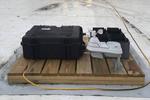
“Technology developed at MIT can harness temperature fluctuations of many kinds to produce electricity. Thermoelectric devices, which can generate power when one side of the device is a different temperature from the other, have been the subject of much research …
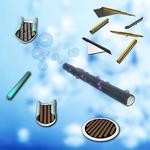
“Researchers of the ICN2 Nanobioelectronics and Biosensors Group led by Prof. Arben Merkoçi have devised a simple manufacturing method for versatile graphene oxide-based micromotors. Requiring no specialist equipment, it can be used to produce a range of micromotors that can …