

Other
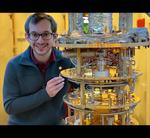
“Work also promises new insights into superconductivity In a feat worthy of a laboratory conceived by J.K. Rowling, MIT researchers and colleagues have turned a “magic” material composed of atomically thin layers of carbon into three useful electronic devices …
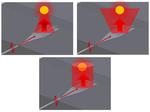
“Design of miniature optical systems could lead to future cell phones that can detect viruses and more. In work that could someday turn cell phones into sensors capable of detecting viruses and other minuscule objects, MIT researchers have built a …

“The findings could lead to faster, more secure memory storage, in the form of antiferromagnetic bits. When you save an image to your smartphone, those data are written onto tiny transistors that are electrically switched on or off in a …
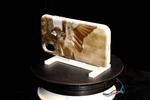
““Programmable matter” technique could enable product designers to churn out prototypes with ease. When was the last time you repainted your car? Redesigned your coffee mug collection? Gave your shoes a colorful facelift? You likely answered: never, never, and never …
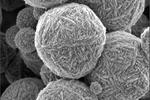
“Study explores the mechanical properties of these materials as they evolve from elastic gels to glassy solids. Researchers at MIT have developed a new method for determining the structure and behavior of a class of widely used soft materials known …
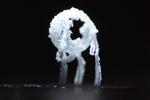
“Crystallizing salts can grow “legs,” then tip over and fall away, potentially helping to prevent fouling of metal surfaces, researchers find. About a quarter of a percent of the entire gross domestic product of industrialized countries is estimated to be …
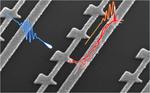
“MIT researchers develop compact on-chip device for detecting electric-field waveforms with attosecond time resolution. Understanding how light waves oscillate in time as they interact with materials is essential to understanding light-driven energy transfer in materials, such as solar cells or …
“The findings pave the way to develop more efficient next-gen LEDs that cover the entire visible spectrum. Researchers from the Low Energy Electronic Systems (LEES) interdisciplinary research group at Singapore-MIT Alliance for Research and Technology (SMART), MIT’s research …
“We’ve come a long way since Intel introduced the first microprocessor in 1971. Their 4004 held 2,300 transistors, with today’s best chips exceeding billions, harnessing more and more power since their birth. But every time Intel releases …
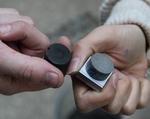
“A collaboration between MIT and CNRS has yielded a cement that conducts electricity and generates heat. Since its invention several millennia ago, concrete has become instrumental to the advancement of civilization, finding use in countless construction applications — from bridges to …