

Other
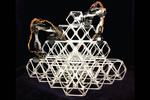
“Systems of tiny robots may someday build high-performance structures, from airplanes to space settlements. Today’s commercial aircraft are typically manufactured in sections, often in different locations — wings at one factory, fuselage sections at another, tail components somewhere else — and …

“An algorithm speeds up the planning process robots use to adjust their grip on objects, for picking and sorting, or tool use. If you’re at a desk with a pen or pencil handy, try this move: Grab the pen …

“The X-ray-focusing lens used in the experiment is based on a design used in lighthouses for centuries. A fractal is any geometric pattern that occurs again and again, at different sizes and scales, within the same object. This “self-similarity” can …
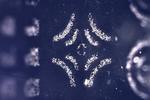
“New technique could enable assembly of circuit boards and displays with more minute components. If you were to pry open your smartphone, you would see an array of electronic chips and components laid out across a circuit board, like a …

“MIT engineers develop a model that predicts how the cornstarch-water mixture turns from liquid to solid, and back again. It’s a phenomenon many preschoolers know well: When you mix cornstarch and water, weird things happen. Swish it gently in …

“Study of minerals widely used in industrial processes could lead to discovery of new materials for catalysis and filtering. Zeolites are a class of natural or manufactured minerals with a sponge-like structure, riddled with tiny pores that make them useful …
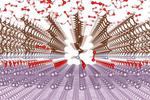
“Ultrathin coating could protect 2D materials from corrosion, enabling their use in optics and electronics. A variety of two-dimensional materials that have promising properties for optical, electronic, or optoelectronic applications have been held back by the fact that they quickly …
“Studying a common material at room temperature, researchers bring quantum behavior “closer to our daily life.” When a guitar string is plucked, it vibrates as any vibrating object would, rising and falling like a wave, as the laws of classical …

“New method from MIT’s research enterprise in Singapore paves the way for improved optoelectronic and 5G devices. The Singapore-MIT Alliance for Research and Technology (SMART), MIT’s research enterprise in Singapore, has announced the successful development of a …
“MIT researchers discover why magnetism in certain materials is different in atomically thin layers and their bulk forms. Researchers led by MIT Department of Physics Professor Pablo Jarillo-Herrero last year showed that rotating layers of hexagonally structured graphene at a …