

Other
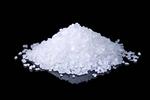
“Industrial forecasts predict an insatiable need for battery farms to store renewable energy like solar and wind. Lithium ion batteries may remain tops for sheer performance, but when cost-per-storage is factored in, a Stanford design based on sodium ions offers …
News SLAC-Led Project Will Use Artificial Intelligence to Prevent or Minimize Electric Grid Failures
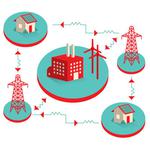
“A project led by the Department of Energy’s SLAC National Accelerator Laboratory will combine artificial intelligence with massive amounts of data and industry experience from a dozen U.S. partners to identify places where the electric grid is vulnerable …
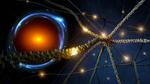
“SLAC and Stanford researchers demonstrate that brain-mimicking ‘neural networks’ can revolutionize the way astrophysicists analyze their most complex data, including extreme distortions in spacetime that are crucial for our understanding of the universe. August 30, 2017 Menlo Park, Calif. — Researchers …
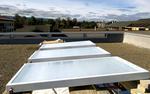
“Stanford scientists cooled water without electricity by sending excess heat where it won’t be noticed – space. The specialized optical surfaces they developed are a major step toward applying this technology to air conditioning and refrigeration. It looks like a …

“Packing tiny solar cells together, like micro-lenses in the compound eye of an insect, could pave the way to a new generation of advanced photovoltaics, say Stanford University scientists. In a new study, the Stanford team used the insect-inspired design …
News New ultrathin semiconductor materials exceed some of silicon’s ‘secret’ powers, Stanford engineers find

“Chip makers appreciate what most consumers never knew: silicon’s virtues include the fact that it “rusts” in a way that insulates its tiny circuitry. Two new ultrathin materials share that trait and outdo silicon in other ways that make …

“Some of the world’s tiniest crystals are known as “artificial atoms” because they can organize themselves into structures that look like molecules, including “superlattices” that are potential building blocks for novel materials. Now scientists from the Department of Energy …
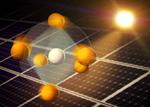
” In recent years, perovskites have taken the solar cell industry by storm. They are cheap, easy to produce and very flexible in their applications. Their efficiency at converting light into electricity has grown faster than that of any other material …
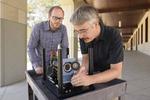
“Stanford engineers have developed a 4D camera with an extra-wide field of view. They believe this camera can be better than current options for close-up robotic vision and augmented reality. A new camera that builds on technology first described by …

“The world is already well on its way to a day when innumerable autonomous cars and drones buzz about, shuffling commuters to work and packages to doorsteps. In fact, there is new term for it floating around the circles of …