

Other

“It’s nearly impossible to break a dry spaghetti noodle into only two pieces. A new MIT study shows how and why it can be done. If you happen to have a box of spaghetti in your pantry, try this …

“Research led by the MIT Haystack Observatory finds arctic winter stratospheric events dramatically affect the ionosphere at night. Forecasting space weather is even more challenging than regular meteorology. The ionosphere — the upper atmospheric layer containing particles charged by solar radiation …
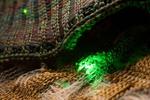
“Researchers incorporate optoelectronic diodes into fibers and weave them into washable fabrics. The latest development in textiles and fibers is a kind of soft hardware that you can wear: cloth that has electronic devices built right into it. Researchers at …
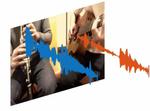
“Given a video of a musical performance, CSAIL’s deep-learning system can make individual instruments louder or softer. Amateur and professional musicians alike may spend hours pouring over YouTube clips to figure out exactly how to play certain parts of …
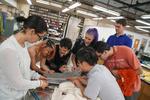
“Advanced Functional Fabrics of America workshop challenges pioneering MIT and FIT students to conceive new ideas. A T-shirt that can change color to complement your mood (and help you pare down your wardrobe). An apron that transforms into a dress …
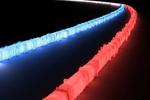
“Silicon-based system offers smaller, cheaper alternative to other “broadband” filters; could improve a variety of photonic devices. MIT researchers have designed an optical filter on a chip that can process optical signals from across an extremely wide spectrum of light …

“Personalized machine-learning models capture subtle variations in facial expressions to better gauge how we feel. MIT Media Lab researchers have developed a machine-learning model that takes computers a step closer to interpreting our emotions as naturally as humans do. In …
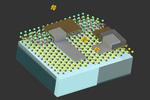
“Made of electronic circuits coupled to minute particles, the devices could flow through intestines or pipelines to detect problems. Researchers at MIT have created what may be the smallest robots yet that can sense their environment, store data, and even …
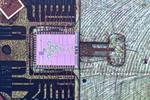
“Novel chip keeps time using the constant, measurable rotation of molecules as a timing reference. MIT researchers have developed the first molecular clock on a chip, which uses the constant, measurable rotation of molecules — when exposed to a certain frequency …
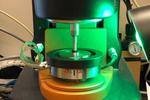
“New material reversibly changes its structure in response to different wavelengths of light. MIT researchers have designed a polymer material that can change its structure in response to light, converting from a rigid substance to a softer one that can …