

Other
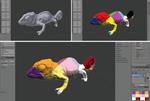
“Computer Science and Artificial Intelligence Laboratory team creates new reprogrammable ink that lets objects change colors using light. The color-changing capabilities of chameleons have long bewildered willing observers. The philosopher Aristotle himself was long mystified by these adaptive creatures. But …
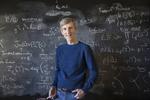
“Mathematics researcher Drew Sutherland helps solve decades-old sum-of-three-cubes puzzle, with help from “The Hitchhiker’s Guide to the Galaxy.” A team led by Andrew Sutherland of MIT and Andrew Booker of Bristol University has solved the final piece of a …
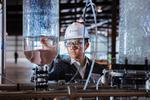
“Solugen’s engineered enzymes offer a cheaper, safer, and far less toxic way to produce the chemical. The most common process for making hydrogen peroxide begins with a highly toxic, flammable working solution that is combined with hydrogen, filtered, combined …
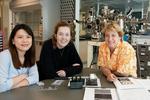
“MIT Professor Frances Ross is pioneering new techniques to study materials growth and how structure relates to performance. A hundred years ago, “2d” meant a two-penny, or 1-inch, nail. Today, “2-D” encompasses a broad range of atomically thin flat materials …

“Low-cost “piezoelectric” films produce voltage, could be used for flexible electronic components and more. MIT researchers have developed a simple, low-cost method to 3-D print ultrathin films with high-performing “piezoelectric” properties, which could be used for components in flexible electronics …
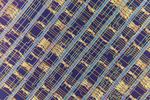
“New approach harnesses the same fabrication processes used for silicon chips, offers key advance toward next-generation computers. After years of tackling numerous design and manufacturing challenges, MIT researchers have built a modern microprocessor from carbon nanotube transistors, which are widely …
“Submerged system uses the vibration of “piezoelectric” materials to generate power and send and receive data. To investigate the vastly unexplored oceans covering most our planet, researchers aim to build a submerged network of interconnected sensors that send data to …
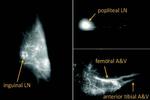
“Shining light through household bleach creates fluorescent quantum defects in carbon nanotubes for quantum computing and biomedical imaging. Quantum computing and quantum cryptography are expected to give much higher capabilities than their classical counterparts. For example, the computation power in …
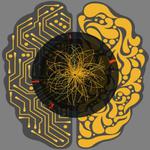
“Prototype machine-learning technology co-developed by MIT scientists speeds processing by up to 175 times over traditional methods. A new machine learning technology tested by an international team of scientists including MIT Assistant Professor Philip Harris and postdoc Dylan Rankin, both …
“MIT researchers have developed a new technique to reveal the uncharted dynamics of electrons in materials. A new technique developed by a team at MIT can map the complete electronic band structure of materials at high resolution. This capability is …