

Other

“Computers can beat chess champions, simulate star explosions, and forecast global climate. We are even teaching them to be infallible problem-solvers and fast learners. And now, physicists at the Department of Energy’s Lawrence Berkeley National Laboratory (Berkeley Lab) and …
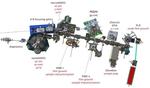
“To see what is driving the exotic behavior in some atomically thin – or 2-D – materials, and find out what happens when they are stacked like Lego bricks in different combinations with other ultrathin materials, scientists want to observe their properties …
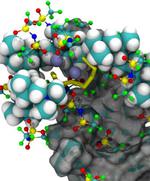
“A new polymer raises the bar for lithium-sulfur batteries Lithium-sulfur batteries are promising candidates for replacing common lithium-ion batteries in electric vehicles since they are cheaper, weigh less, and can store nearly double the energy for the same mass. However …
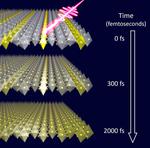
“Stripes can be found everywhere, from zebras roaming in the wild to the latest fashion statement. In the world of microscopic physics, periodic stripe patterns can be formed by electrons within so-called quantum materials. Scientists at the Department of Energy …

“Novel defect control in graphene enables direct imaging of trapped electrons that follow Einstein’s rules. The Science Imaging electrons can help scientists better understand exotic electronic states, such as electricity that travels through wires without loss. The team created …
“A team of Department of Energy (DOE) scientists at the Joint Center for Energy Storage Research (JCESR) has discovered the fastest magnesium-ion solid-state conductor, a major step towards making solid-state magnesium-ion batteries that are both energy dense and safe. The …

“Neutrinos are abundant subatomic particles that are famous for passing through anything and everything, only very rarely interacting with matter. About 100 trillion neutrinos pass through your body every second. Now, scientists have demonstrated that the Earth stops energetic neutrinos …
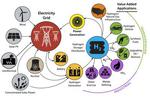
“While hydrogen is often talked about as a pollution-free fuel of the future, especially for use in fuel cell electric vehicles, hydrogen can be used for much more than zero-emission cars. In fact, from enhancing the flexibility of the grid …

“For more than 50 years, Moore’s Law has reigned supreme. The observation that the number of transistors on a computer chip doubles roughly every two years has set the pace for our modern digital revolution—making smartphones, personal computers …

“On an otherwise normal day in the lab, Eva Andrei didn’t expect to make a major discovery. Andrei, a physics professor at Rutgers University, was using graphite – the material in pencils – to calibrate a scanning tunneling microscope. As part …