

Other

“A new paper published in Nature shows potential for graphene bolometers to become a game-changer for quantum technology Physicists at Aalto University and VTT Technical Research Centre of Finland have developed a new detector for measuring energy quanta at unprecedented …
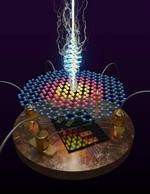
“Army-funded research developed a new microwave radiation sensor with 100,000 times higher sensitivity than currently available commercial sensors. Researchers said better detection of microwave radiation will enable improved thermal imaging, electronic warfare, radio communications and radar. Researchers published their …

“Leiden physicists and international colleagues from Geneva and Barcelona have confirmed the mechanism that makes magic-angle graphene superconducting. This is a key step in elucidating high-temperature superconductivity, a decades-old mystery central to physics, which may lead to technological breakthroughs. Magic-angle …
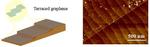
“NUS physicists have developed a sensitive two-dimensional (2-D) magnetic field sensor, which can potentially improve the detection of nanoscale magnetic domains for data storage applications. Magnetoresistance (MR), the change in the electrical resistance of a material due to the influence …
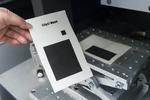
“Face masks have become an important tool in fighting against the COVID-19 pandemic. However, improper use or disposal of masks may lead to “secondary transmission”. A research team from City University of Hong Kong (CityU) has successfully produced graphene …
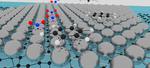
“Researchers at Chalmers University of Technology in Sweden, with collaborators, have reported the possibility to prepare one-atom thin platinum and use it as chemical sensors. The results were recently published in the scientific journal Advanced Material Interfaces. “In a nutshell …
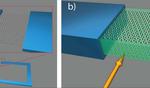
“Physicists at the University of Basel have developed a minuscule instrument able to detect extremely faint magnetic fields. At the heart of the superconducting quantum interference device are two atomically thin layers of graphene, which the researchers combined with boron …
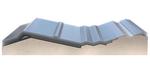
“The powerful electronics packed inside the latest smartphones can be a significant challenge to keep cool. KAUST researchers have developed a fast and efficient way to make a carbon material that could be ideally suited to dissipating heat in electronic …

“In 1959, former Cornell physicist Richard Feynman delivered his famous lecture “There’s Plenty of Room at the Bottom,” in which he described the opportunity for shrinking technology, from machines to computer chips, to incredibly small sizes. Well, the bottom …
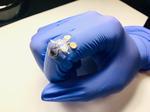
“A stretchable, wearable gas sensor for environmental sensing has been developed and tested by researchers at Penn State, Northeastern University and five universities in China. The sensor combines a newly developed laser-induced graphene foam material with a unique form of …